Music symbols
Written music is a language of symbols. A handful of them — the clef, the notes and rests, the accidentals, the dynamics — carry almost everything you need to play a piece. Below is every common symbol, grouped by what it does, with a free printable chart to keep on the music stand.
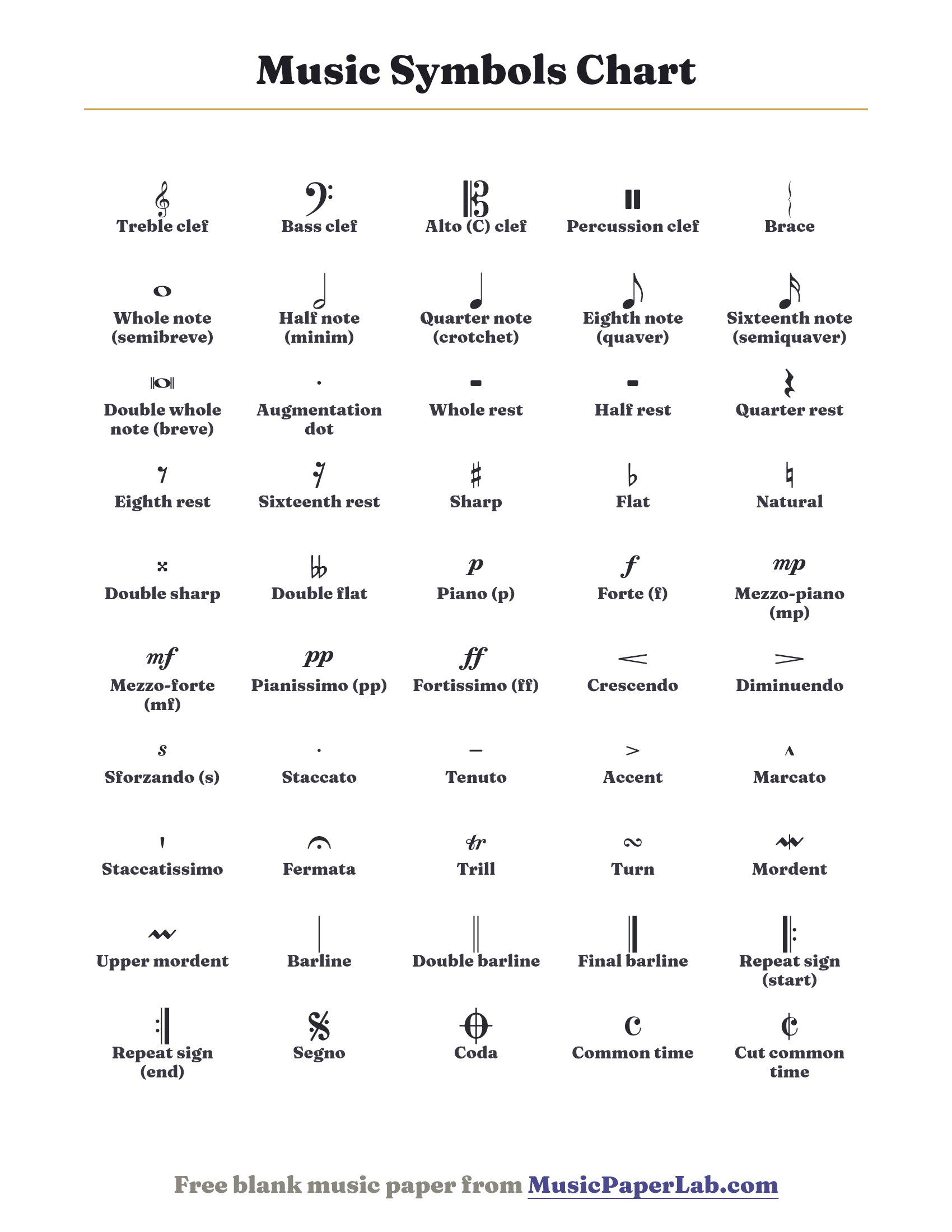
Music symbols by type
Clefs
Clefs sit at the start of the staff and fix which pitch each line and space represents.
- Treble clef
- Also called the G clef: it curls around the second line to mark the G above middle C. Used by violin, flute, trumpet, guitar and the right hand on piano.
- Bass clef
- Also called the F clef: its two dots sit either side of the fourth line to mark the F below middle C. Used by cello, bass, trombone and the left hand on piano.
- Alto (C) clef
- A C clef centred on the middle line, which marks middle C. Read mainly by the viola. Moved to the fourth line it becomes the tenor clef.
- Percussion clef
- Two thick vertical strokes showing the staff carries rhythm on unpitched instruments rather than pitches.
- Brace
- Joins two staves into a grand staff, showing they are played together by one performer — as on piano.
Notes & note values
Note symbols show both the pitch (by position on the staff) and how long the note lasts.
- Whole note (semibreve)
- An open notehead with no stem, lasting four beats in common time — the longest note in everyday use.
- Half note (minim)
- An open notehead with a stem, lasting two beats in common time.
- Quarter note (crotchet)
- A filled notehead with a stem, lasting one beat in common time — the usual "counting" beat.
- Eighth note (quaver)
- A filled notehead with a stem and one flag, lasting half a beat. Two of them fill one quarter note.
- Sixteenth note (semiquaver)
- A filled notehead with two flags, lasting a quarter of a beat.
- Double whole note (breve)
- A rare, very long note worth two whole notes — eight beats in common time.
- Augmentation dot
- A dot after a note adds half its value again: a dotted half note lasts three beats instead of two.
Rests
A rest is a measured silence. Each note value has a matching rest of the same length.
- Whole rest
- A filled rectangle hanging below the fourth line. Lasts four beats, or a whole bar of silence.
- Half rest
- A filled rectangle sitting on top of the middle line, lasting two beats. The mirror image of the whole rest.
- Quarter rest
- A single beat of silence — the squiggle shape most people picture when they think of a rest.
- Eighth rest
- Half a beat of silence, drawn with one flag.
- Sixteenth rest
- A quarter of a beat of silence, drawn with two flags.
Accidentals
Accidentals raise or lower a note by a semitone, either in the key signature or in the bar.
- Sharp
- Raises the note by one semitone. In a key signature it applies to that note in every octave for the whole piece.
- Flat
- Lowers the note by one semitone.
- Natural
- Cancels a previous sharp or flat, returning the note to its natural pitch.
- Double sharp
- Raises the note by two semitones (a whole tone). Written as a small cross.
- Double flat
- Lowers the note by two semitones, written as two flats together.
Dynamics
Dynamics tell you how loudly or softly to play, and where to grow or fade.
- Piano (p)
- Play softly. From the Italian for "soft".
- Forte (f)
- Play loudly. From the Italian for "strong".
- Mezzo-piano (mp)
- Moderately soft — a little louder than piano.
- Mezzo-forte (mf)
- Moderately loud — a little softer than forte.
- Pianissimo (pp)
- Very soft.
- Fortissimo (ff)
- Very loud.
- Crescendo
- An opening hairpin: gradually get louder across the passage.
- Diminuendo
- A closing hairpin: gradually get softer. Also called decrescendo.
- Sforzando (s)
- A sudden strong accent on a single note or chord, usually written sf or sfz.
Articulations
Articulations shape how a single note is attacked and released — short, held, or accented.
- Staccato
- A dot above or below the note: play it short and detached, roughly half its written length.
- Tenuto
- A short line: hold the note for its full value, slightly stressed.
- Accent
- A horizontal wedge: attack the note more strongly than those around it.
- Marcato
- A vertical wedge: strongly accented and usually slightly shortened — heavier than a normal accent.
- Staccatissimo
- A small vertical wedge: even shorter and more clipped than staccato.
- Fermata
- A "pause": hold the note or rest for longer than written, at the performer’s discretion.
Ornaments
Ornaments decorate a note with extra, usually quicker, neighbouring notes.
- Trill
- Rapidly alternate between the written note and the note above it, usually for the note’s full length.
- Turn
- Play the note above, the written note, the note below, then the written note again.
- Mordent
- A zigzag with a vertical stroke through it. Play the written note, quickly drop to the note below, and return — sometimes called a lower mordent.
- Upper mordent
- The same zigzag without the stroke. Play the written note, flick up to the note above, and return. Also called an inverted mordent or short trill.
Barlines & repeats
Barlines divide music into bars; repeat signs and navigation marks tell you where to go next.
- Barline
- A single vertical line dividing the staff into bars (measures).
- Double barline
- Two thin lines marking the end of a section or a change of key or time signature.
- Final barline
- A thin line followed by a thick one, marking the end of the piece.
- Repeat sign (start)
- Marks the beginning of a section to be repeated.
- Repeat sign (end)
- Marks the end of a repeated section — go back to the matching start repeat.
- Segno
- A navigation marker. "D.S." (dal segno) tells you to jump back to this sign.
- Coda
- Marks the closing section. "To Coda" sends you here to finish the piece.
- Common time
- A "C" standing for 4/4 time: four quarter-note beats in every bar.
- Cut common time
- A struck-through C standing for 2/2 (alla breve): two half-note beats per bar, counted twice as fast.
How the symbols fit together
Reading music is mostly a matter of combining four questions. Which pitch? — answered by the clef and the note's position on the staff, adjusted by any accidentals or the key signature. How long? — answered by the note value and any dots. How loud? — the dynamics. How played? — the articulations and ornaments. Everything else — barlines, repeats, the segno and coda — is navigation, telling you where to go next.
If you are starting from scratch, the guide to reading sheet music walks through these in order. To practise writing them, print some blank staff paper.
Music symbols — frequently asked questions
What are the basic music symbols?
The essentials are the clef (which fixes the pitch of each line), the notes and rests (which set rhythm and silence), the accidentals — sharp, flat and natural — the time signature, and the barlines that divide the music into bars.
What does the ♯ symbol mean in music?
A sharp raises a note by one semitone. Written in the key signature it applies to that note for the whole piece; written in a bar it applies until the end of that bar.
What is the difference between a note and a rest?
A note tells you to play a pitch for a set length. A rest is the same measured length, but silent. Every note value has a matching rest.
What do p and f mean in sheet music?
They are dynamics: p (piano) means play softly and f (forte) means play loudly. Combinations like mp, mf, pp and ff give finer degrees between them.
How many music symbols are there?
The full SMuFL standard catalogues thousands of specialist glyphs, but everyday sheet music uses a few dozen. The chart on this page covers the ones you will actually meet.
Is the music symbols chart free to print?
Yes — print it or download the PDF or PNG for free, with no account or sign-up.