The circle of fifths
The circle of fifths is the single most useful diagram in music theory. It arranges all twelve keys so you can see, at a glance, how many sharps or flats each one has, which minor key it shares a signature with, and which chords sound good together. Tap a key on the circle below to see its signature, scale and chords (and hear them), or scroll down for the printable chart.
Click or tap any key. On a keyboard, Tab to the circle, then use ← → to move around it and ↑ ↓ to switch between the major and minor rings.
C major
No sharps or flats
- Relative minor
- (same key signature)
- Scale
- C D E F G A B
- Next door
- and , one sharp or flat away
Chords in C major tap one to hear it
Piano diagrams: C · Dm · Em · F · G · Am · B°
C major key signature · C major scale on piano · chord progression chart
Printable circle of fifths chart
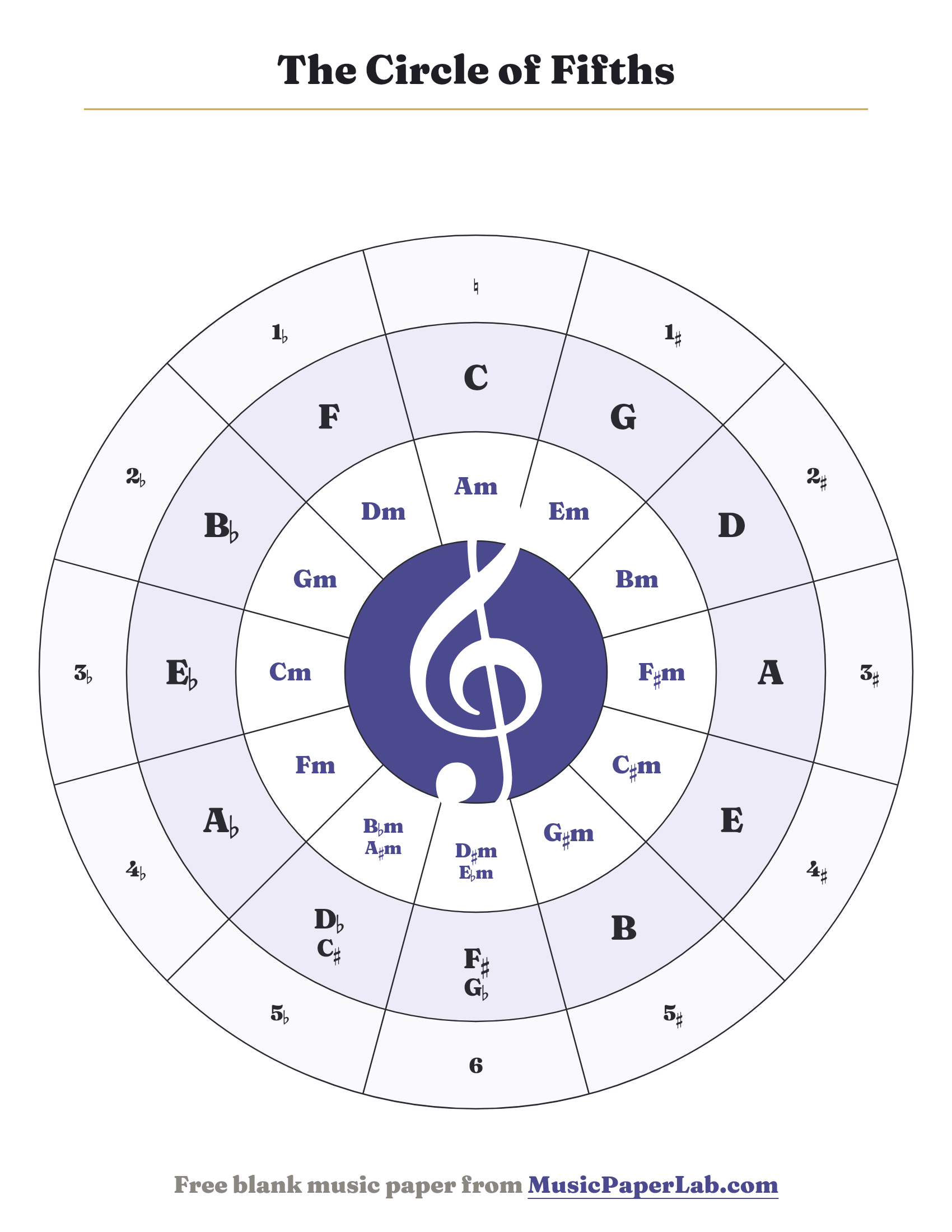
What is the circle of fifths?
The circle of fifths lays out the twelve notes of music not in a straight line, but in a ring ordered by perfect fifths. Starting from C at the top and moving clockwise, every note is a fifth higher than the last: C, G, D, A, E, B, and so on all the way around and back to C. That ordering is powerful because keys that sit next to each other on the circle are closely related — they share almost all of their notes.
How to read the circle
- Outer ring — major keys. The twelve major keys, from C at the top.
- Inner ring — relative minors. Each major key’s relative minor sits just inside it (C major / A minor, G major / E minor…). They share the same key signature.
- Edge numbers — key signatures. How many sharps (clockwise, right-hand side) or flats (counterclockwise, left-hand side) the key has.
Clockwise adds sharps and raises the key by a fifth; counterclockwise adds flats and lowers it by a fifth. At the bottom the two directions meet at the enharmonic keys — F♯ (6 sharps) is the same set of pitches as G♭ (6 flats).
How to use the circle of fifths
- Count the sharps or flats. Start at C (12 o’clock). Each step clockwise adds one sharp (G has 1, D has 2, A has 3…); each step counterclockwise adds one flat (F has 1, B♭ has 2, E♭ has 3…). The number on the outer ring is that key’s key signature.
- Find the relative minor. The inner ring shows each major key’s relative minor — the minor key that shares its key signature. C major and A minor sit in the same segment, G major and E minor, and so on.
- Build the main chords of a key. A key and its two neighbours give you its three primary chords. For C: F (one step counterclockwise) is the IV chord and G (one step clockwise) is the V chord. Those three chords harmonize most simple songs.
- Write a chord progression. Moving one step counterclockwise around the circle (V → I) is the strongest resolution in music — it is the perfect cadence. Progressions that walk around the circle, like vi–ii–V–I, sound satisfying because each chord is a fifth apart.
- Change key smoothly. Neighboring keys differ by just one sharp or flat, so they are the easiest keys to modulate between. To brighten a song, move one step clockwise; to darken it, move counterclockwise.
Key signatures at a glance
The circle is the fastest way to recall a key signature. Sharps are added in the order F♯ C♯ G♯ D♯ A♯ E♯ B♯ (clockwise), and flats in the mirror order B♭ E♭ A♭ D♭ G♭ C♭ F♭ (counterclockwise). If you want to write music in any of these keys, print some blank staff paper or open the music paper generator and add the key signature yourself.
Relative minors
Every major key has a relative minor three semitones below it that uses exactly the same notes — C major and A minor, or G major and E minor. The inner ring pairs them up, which makes it easy to switch between a bright major sound and its darker minor cousin without changing key signature. The minor key signatures chart lists all fifteen. Once you know a key, try its piano chords, guitar chords and scales, or look up every key’s chords on the chord progression chart.
Circle of fifths — frequently asked questions
What is the circle of fifths?
The circle of fifths is a diagram that arranges the twelve musical keys around a circle in order of their key signatures. Moving clockwise, each key is a perfect fifth higher and has one more sharp; moving counterclockwise, each key is a fifth lower and has one more flat.
How do you read the circle of fifths?
The outer ring lists the major keys, the inner ring lists their relative minors, and the numbers around the edge show how many sharps or flats each key has. C is at the top with no sharps or flats; sharps increase going clockwise and flats increase going counterclockwise.
Why is it called the circle of fifths?
Because each step clockwise moves up a perfect fifth: C to G, G to D, D to A, and so on. After twelve fifths you arrive back at C, completing the circle.
What is the circle of fifths used for?
It is used to work out key signatures, find relative minor keys, build the primary chords of a key, write strong chord progressions, transpose music, and change key smoothly.
Which keys have the most sharps or flats?
At the bottom of the circle, F♯ major has six sharps and its enharmonic equivalent G♭ major has six flats. C♯ major (seven sharps) and C♭ major (seven flats) are the extremes.
Is the circle of fifths chart free to print?
Yes — this circle of fifths is free to print or download as a PDF or PNG, with no account or sign-up.
Print your own
Blank circle of fifths
Fill it in yourself — a printable practice worksheet
Clef notes
Read the notes on every clef
Guitar scales
Every scale across the fretboard
Chord progression chart
The chords in every major and minor key
Minor key signatures
All 15 minor keys on treble and bass clef
All music theory charts
Every free reference chart on the site