Clefs
Clefs sit at the start of the staff and fix which pitch each line and space represents.
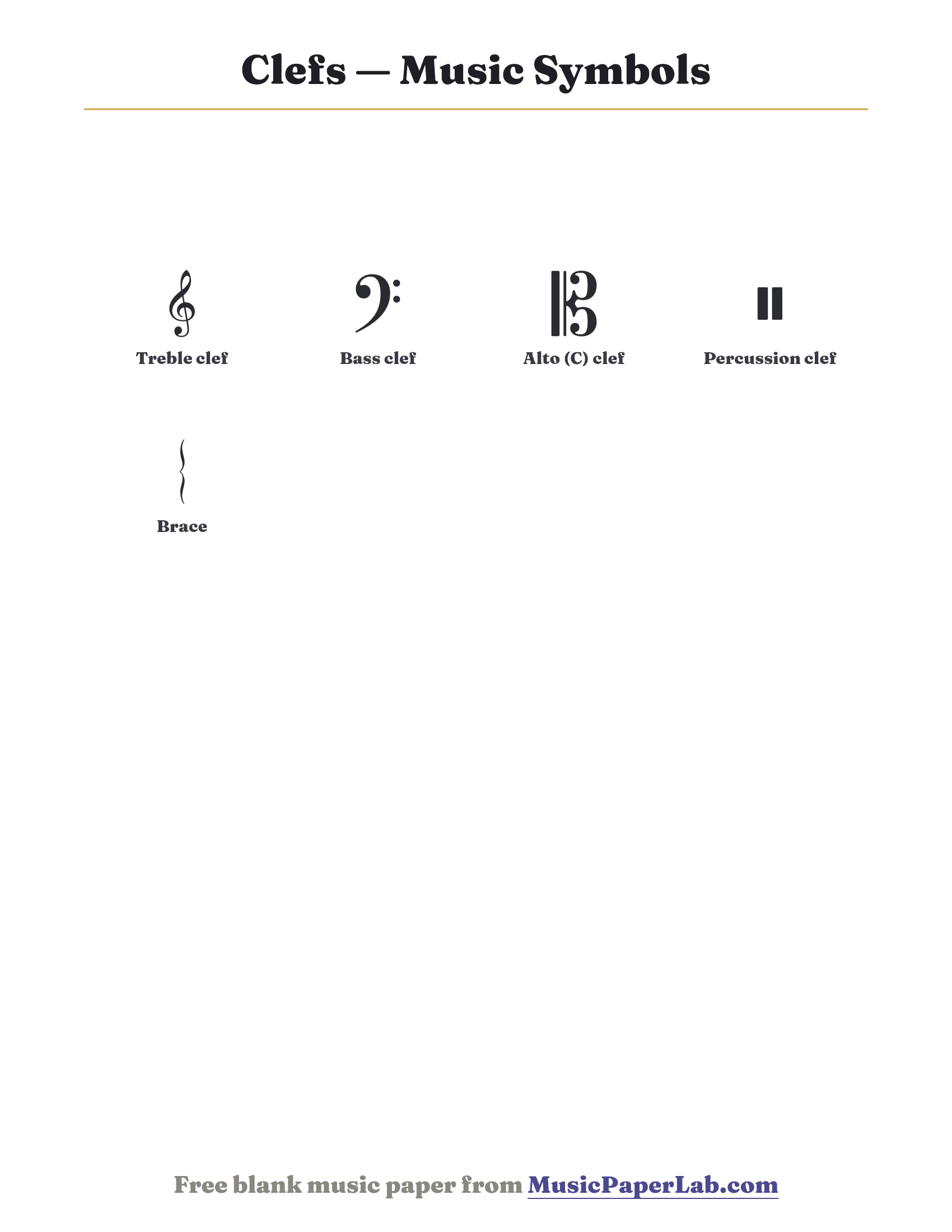
Clefs explained
- Treble clef
- Also called the G clef: it curls around the second line to mark the G above middle C. Used by violin, flute, trumpet, guitar and the right hand on piano.
- Bass clef
- Also called the F clef: its two dots sit either side of the fourth line to mark the F below middle C. Used by cello, bass, trombone and the left hand on piano.
- Alto (C) clef
- A C clef centred on the middle line, which marks middle C. Read mainly by the viola. Moved to the fourth line it becomes the tenor clef.
- Percussion clef
- Two thick vertical strokes showing the staff carries rhythm on unpitched instruments rather than pitches.
- Brace
- Joins two staves into a grand staff, showing they are played together by one performer — as on piano.
Clefs — frequently asked questions
What clefs are used in sheet music?
This page covers 5: Treble clef, Bass clef, Alto (C) clef, Percussion clef, Brace.
What does the treble clef symbol mean?
Also called the G clef: it curls around the second line to mark the G above middle C. Used by violin, flute, trumpet, guitar and the right hand on piano.
What does the bass clef symbol mean?
Also called the F clef: its two dots sit either side of the fourth line to mark the F below middle C. Used by cello, bass, trombone and the left hand on piano.
What does the alto (c) clef symbol mean?
A C clef centred on the middle line, which marks middle C. Read mainly by the viola. Moved to the fourth line it becomes the tenor clef.
What does the percussion clef symbol mean?
Two thick vertical strokes showing the staff carries rhythm on unpitched instruments rather than pitches.
Is the clefs chart free to print?
Yes — print it or download the PDF or PNG for free, with no sign-up.