Notes & note values
Note symbols show both the pitch (by position on the staff) and how long the note lasts.
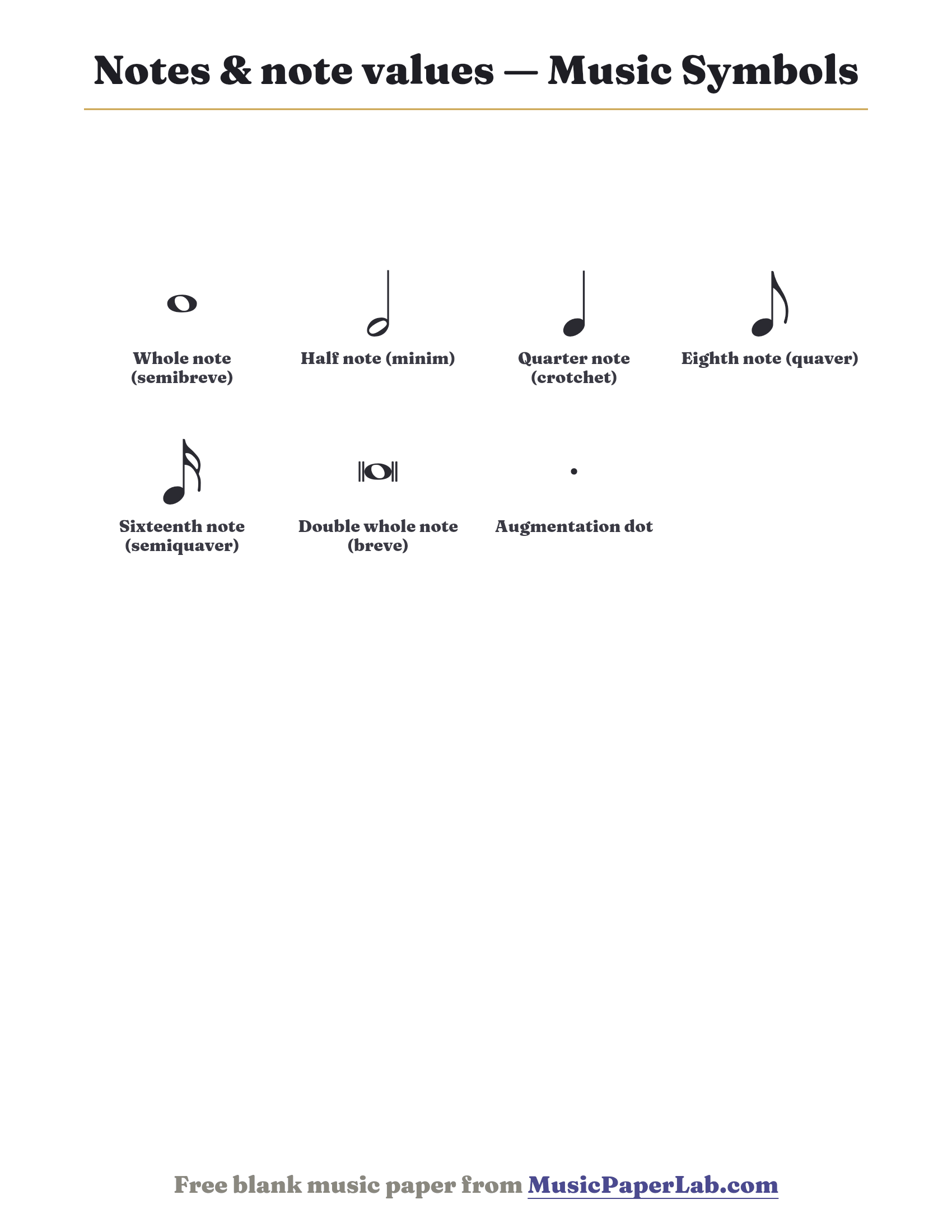
Notes & note values explained
- Whole note (semibreve)
- An open notehead with no stem, lasting four beats in common time — the longest note in everyday use.
- Half note (minim)
- An open notehead with a stem, lasting two beats in common time.
- Quarter note (crotchet)
- A filled notehead with a stem, lasting one beat in common time — the usual "counting" beat.
- Eighth note (quaver)
- A filled notehead with a stem and one flag, lasting half a beat. Two of them fill one quarter note.
- Sixteenth note (semiquaver)
- A filled notehead with two flags, lasting a quarter of a beat.
- Double whole note (breve)
- A rare, very long note worth two whole notes — eight beats in common time.
- Augmentation dot
- A dot after a note adds half its value again: a dotted half note lasts three beats instead of two.
Notes & note values — frequently asked questions
What notes & note values are used in sheet music?
This page covers 7: Whole note (semibreve), Half note (minim), Quarter note (crotchet), Eighth note (quaver), Sixteenth note (semiquaver), Double whole note (breve), Augmentation dot.
What does the whole note (semibreve) symbol mean?
An open notehead with no stem, lasting four beats in common time — the longest note in everyday use.
What does the half note (minim) symbol mean?
An open notehead with a stem, lasting two beats in common time.
What does the quarter note (crotchet) symbol mean?
A filled notehead with a stem, lasting one beat in common time — the usual "counting" beat.
What does the eighth note (quaver) symbol mean?
A filled notehead with a stem and one flag, lasting half a beat. Two of them fill one quarter note.
Is the notes & note values chart free to print?
Yes — print it or download the PDF or PNG for free, with no sign-up.