Barlines & repeats
Barlines divide music into bars; repeat signs and navigation marks tell you where to go next.
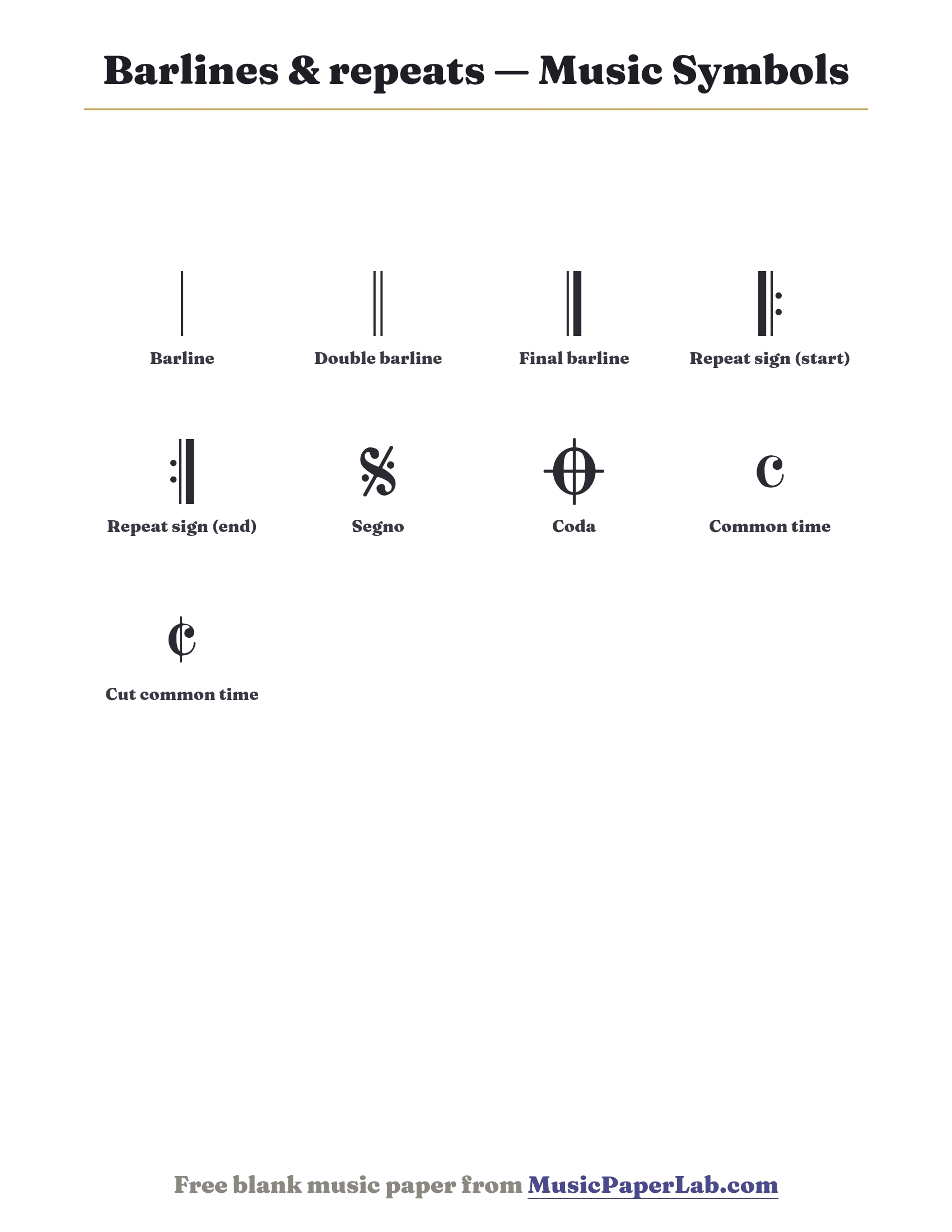
Barlines & repeats explained
- Barline
- A single vertical line dividing the staff into bars (measures).
- Double barline
- Two thin lines marking the end of a section or a change of key or time signature.
- Final barline
- A thin line followed by a thick one, marking the end of the piece.
- Repeat sign (start)
- Marks the beginning of a section to be repeated.
- Repeat sign (end)
- Marks the end of a repeated section — go back to the matching start repeat.
- Segno
- A navigation marker. "D.S." (dal segno) tells you to jump back to this sign.
- Coda
- Marks the closing section. "To Coda" sends you here to finish the piece.
- Common time
- A "C" standing for 4/4 time: four quarter-note beats in every bar.
- Cut common time
- A struck-through C standing for 2/2 (alla breve): two half-note beats per bar, counted twice as fast.
Barlines & repeats — frequently asked questions
What barlines & repeats are used in sheet music?
This page covers 9: Barline, Double barline, Final barline, Repeat sign (start), Repeat sign (end), Segno, Coda, Common time, Cut common time.
What does the barline symbol mean?
A single vertical line dividing the staff into bars (measures).
What does the double barline symbol mean?
Two thin lines marking the end of a section or a change of key or time signature.
What does the final barline symbol mean?
A thin line followed by a thick one, marking the end of the piece.
What does the repeat sign (start) symbol mean?
Marks the beginning of a section to be repeated.
Is the barlines & repeats chart free to print?
Yes — print it or download the PDF or PNG for free, with no sign-up.