Time signatures
A time signature is the pair of stacked numbers at the start of a piece, just after the clef and key signature. In most music the top number is how many beats are in each measure and the bottom number is the note value that gets one beat. The chart shows the twelve you will see most often, what each one counts, and whether it is simple, compound or irregular.
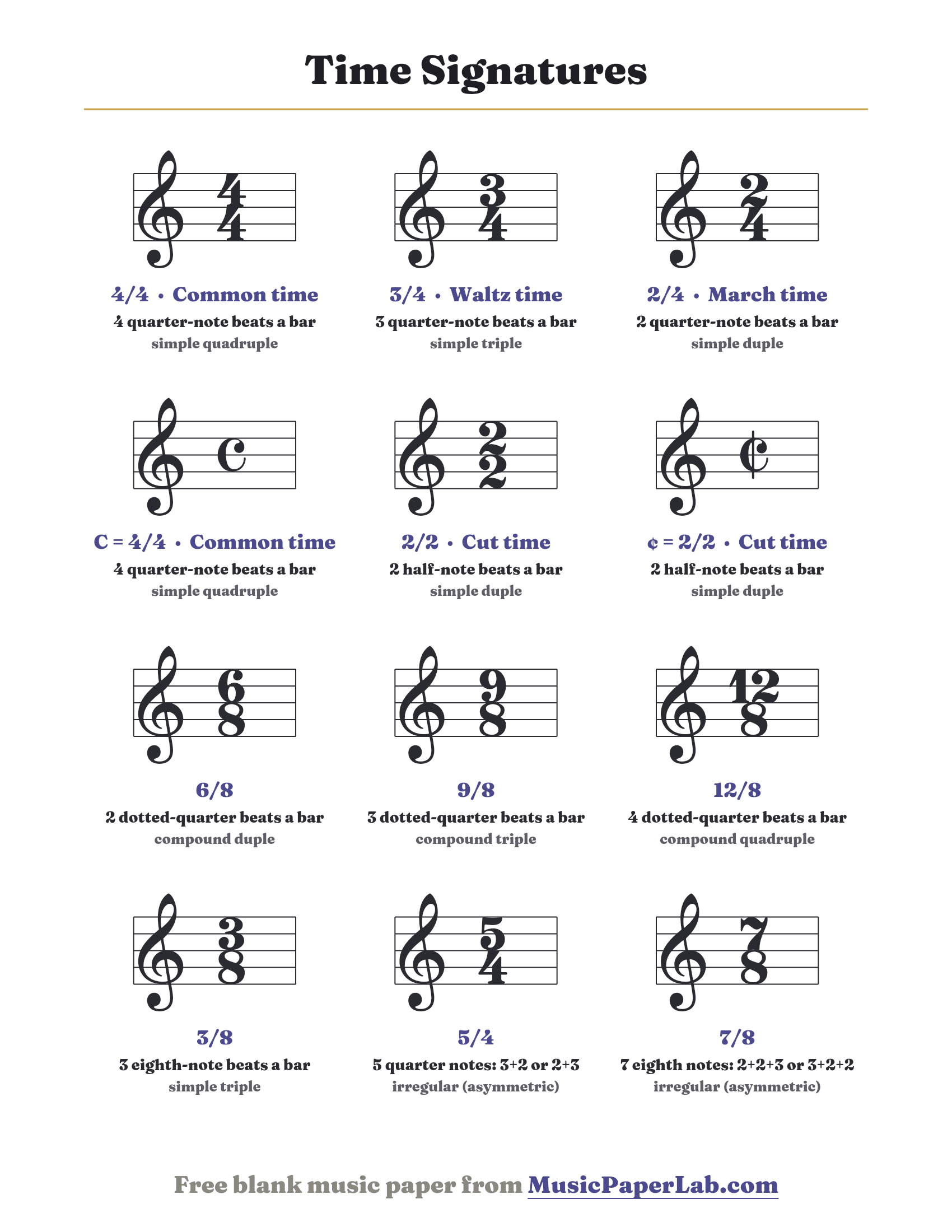
What the numbers mean
The bottom number names a note value: 2 for a half note, 4 for a quarter note, 8 for an eighth note and 16 for a sixteenth note. The top number says how many of those fill a measure. So 3/4 is three quarter notes per measure and 2/2 is two half notes.
| Time signature | Beats per measure | Type | Count it |
|---|---|---|---|
| 4/4 (common time) | 4 quarter-note beats | simple quadruple | 1 2 3 4 |
| 3/4 (waltz time) | 3 quarter-note beats | simple triple | 1 2 3 |
| 2/4 (march time) | 2 quarter-note beats | simple duple | 1 2 |
| 2/2 (cut time) | 2 half-note beats | simple duple | 1 2 |
| 6/8 | 2 dotted-quarter beats | compound duple | 1 2 3 4 5 6 (stress 1, 4) |
| 9/8 | 3 dotted-quarter beats | compound triple | 1 2 3 4 5 6 7 8 9 (stress 1, 4, 7) |
| 12/8 | 4 dotted-quarter beats | compound quadruple | 1 2 3 4 5 6 7 8 9 10 11 12 (stress 1, 4, 7, 10) |
| 3/8 | 3 eighth-note beats | simple triple | 1 2 3 |
| 5/4 | 5 quarter-note beats | irregular (asymmetric) | 1 2 3 4 5 (in groups like 3+2) |
| 7/8 | 7 eighth-note beats | irregular (asymmetric) | 1 2 3 4 5 6 7 (in groups like 2+2+3) |
Simple, compound and irregular time
In simple time (top number 2, 3 or 4) each beat splits into two: 4/4 counts “1 and 2 and 3 and 4 and.” In compound time (top number 6, 9 or 12) each beat splits into three, and the beat itself is a dotted note. 6/8 has six eighth notes but only two beats, which is why a jig or a slow ballad in 6/8 feels like it is in two.
Meters with 5 or 7 beats are called irregular or asymmetric, because the beats fall into uneven groups. 5/4 is usually felt as 3+2 or 2+3, and 7/8 as 2+2+3 or 3+2+2. The composer often shows the grouping with beams or dotted bar lines.
Common time and cut time
Two time signatures are often written as symbols. A large C means 4/4, and a C with a vertical stroke through it means 2/2, called cut time or alla breve. The C does not stand for “common.” It comes from a broken circle used in medieval notation, where a full circle meant triple time.
Where the time signature goes
The time signature appears once at the start, after the key signature, and again only when the meter changes. Key signatures repeat on every line, but time signatures do not. You can read more about the order of these symbols in how to read sheet music, or print blank staff paper and write some rhythms out yourself.
Time signatures: frequently asked questions
What does 4/4 mean?
Four beats in each measure, with a quarter note getting one beat. It is so common that it is called common time and is often written as a C.
What is the difference between 3/4 and 6/8?
Both hold six eighth notes per measure, but they are grouped differently. 3/4 is simple triple: three quarter-note beats (1-and-2-and-3-and). 6/8 is compound duple: two dotted-quarter beats, each split into three (1-2-3-4-5-6, stressing 1 and 4).
How can I tell simple time from compound time?
Look at the top number. 2, 3 and 4 mean simple time. 6, 9 and 12 mean compound time, where each beat divides into three. Anything else, such as 5 or 7, is an irregular meter.
What is cut time?
Cut time is 2/2: two half-note beats per measure. It is written as a C with a vertical line through it, and you count it in two even when the music looks like 4/4.
Is the time signatures chart free?
Yes. Print it or download the PDF or PNG for free, with no sign-up.
Related charts
The music staff
Lines, spaces and the parts of a staff
Ledger lines
Notes above and below the treble and bass staves
Chord progression chart
The chords in every major and minor key
Note values
Whole, half, quarter and eighth notes
How to read sheet music
The staff, clefs, keys and rhythm in order
All music theory charts
Every free reference chart on the site