Chord progression chart
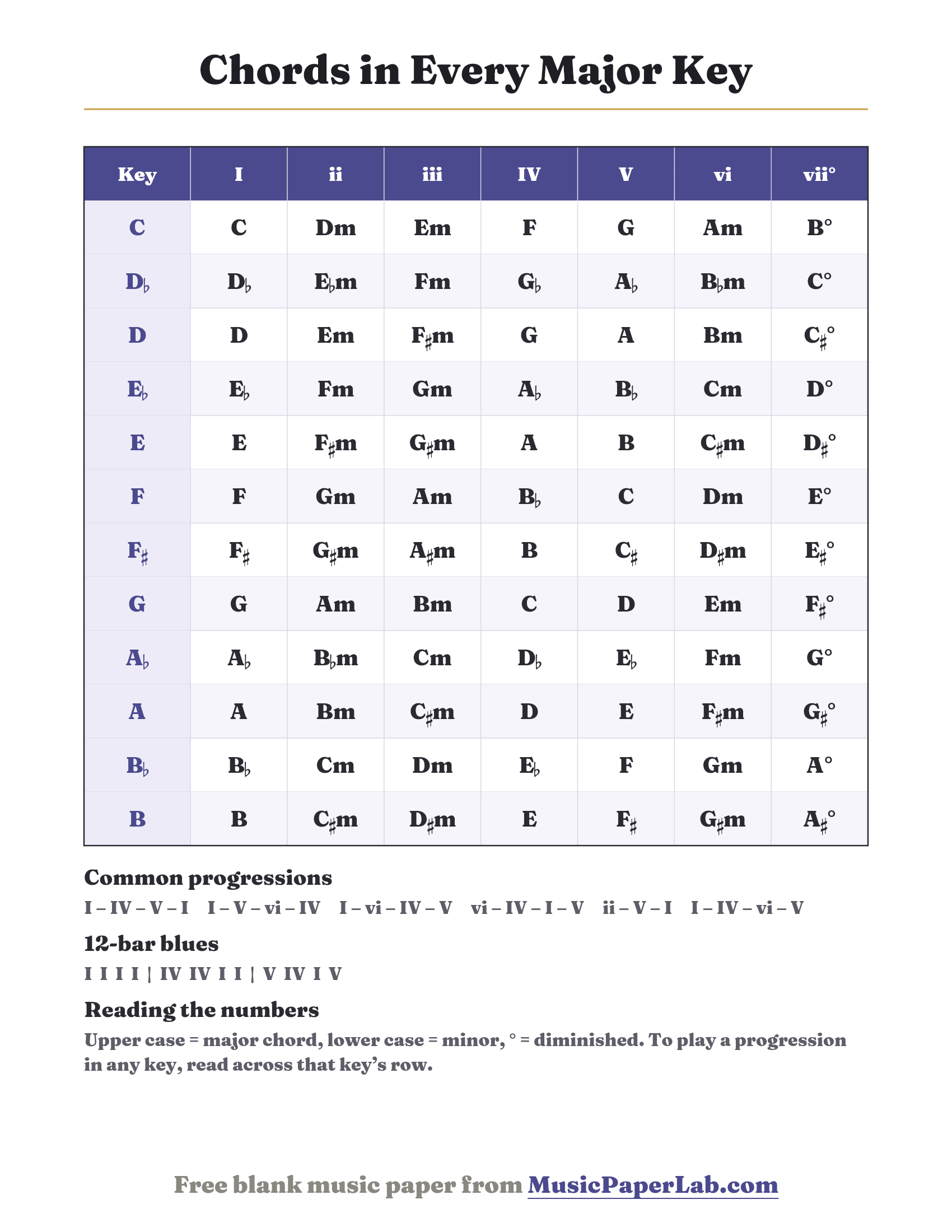
Every major key has seven chords built from its scale, and they always follow the same pattern: I ii iii IV V vi vii°. This chart lists those chords for all 12 major keys, with a second chart for the minor keys. Take any progression written in numbers, like I–V–vi–IV, and you can play it in any key by reading across one row.
How the numbers work
Each Roman numeral is a note of the scale, and the chord built on it. Upper case means a major chord, lower case a minor chord, and ° a diminished chord. In C major, I is C, ii is Dm, V is G and vii° is B°. In G major the same numerals give G, Am, D and F♯°. The numbers stay put while the chord names change with the key, which is why musicians talk about progressions in numbers.
Common progressions
| Progression | In C | In G | In D | Where you hear it |
|---|---|---|---|---|
| I – IV – V – I | C – F – G – C | G – C – D – G | D – G – A – D | The basic cadence: folk, hymns, early rock and roll. |
| I – V – vi – IV | C – G – Am – F | G – D – Em – C | D – A – Bm – G | The most common pop progression of the last 40 years. |
| I – vi – IV – V | C – Am – F – G | G – Em – C – D | D – Bm – G – A | The 1950s doo-wop progression. |
| vi – IV – I – V | Am – F – C – G | Em – C – G – D | Bm – G – D – A | The pop progression started on the minor chord. |
| ii – V – I | Dm – G – C | Am – D – G | Em – A – D | The core jazz cadence. |
| I – IV – vi – V | C – F – Am – G | G – C – Em – D | D – G – Bm – A | The same four chords in another common pop order. |
The 12-bar blues
The blues uses only I, IV and V over twelve measures: I I I I | IV IV I I | V IV I V. In E, a common blues key on guitar, that is E E E E | A A E E | B A E B. Blues players usually turn all three into dominant 7th chords (E7, A7, B7).
Chords in minor keys
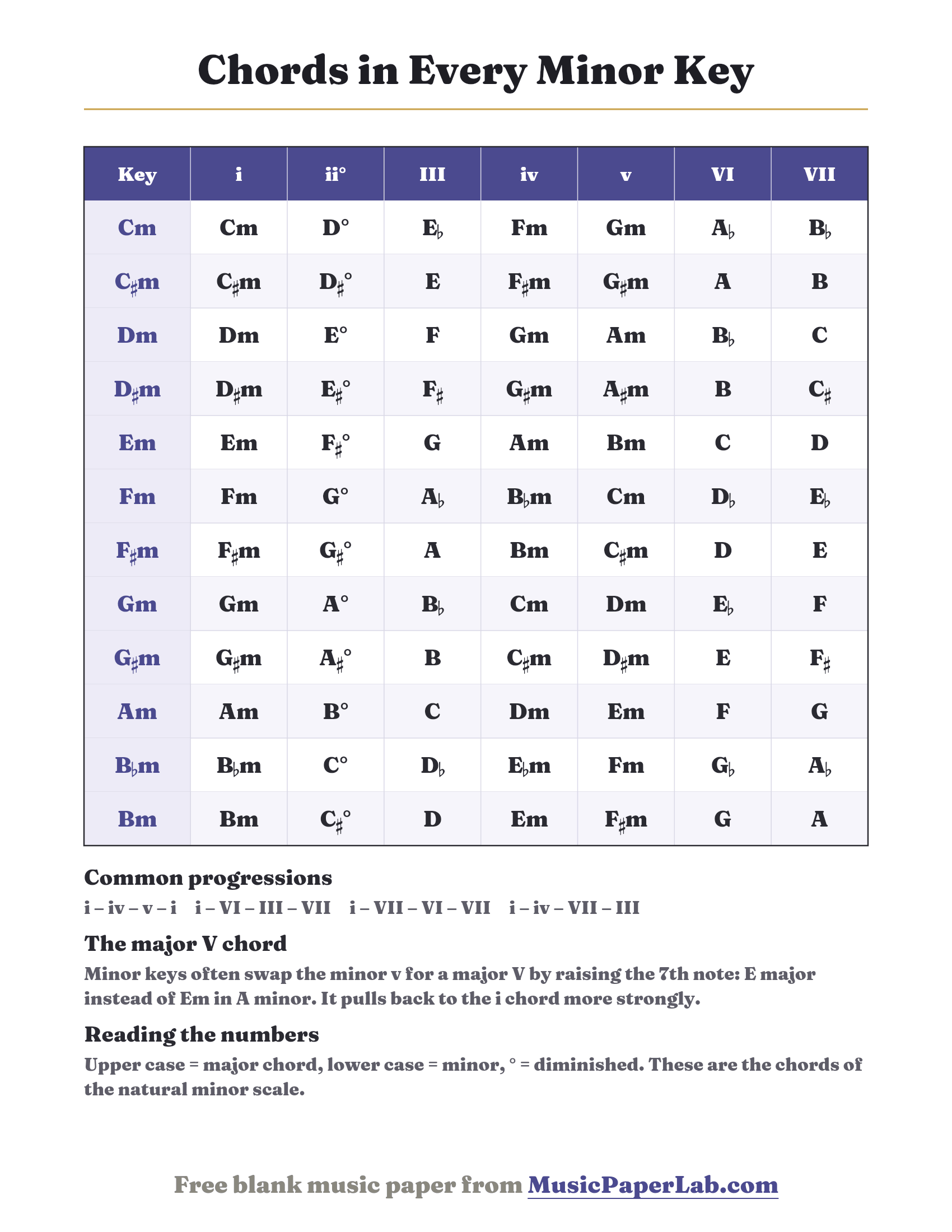
Minor keys follow their own pattern: i ii° III iv v VI VII. These are the chords of the natural minor scale. Most minor-key music also raises the 7th note, which turns the minor v chord into a major V: E instead of Em in A minor. That major V pulls back to the i chord more strongly, so you will often see both in the same song.
| Progression | In A minor | In E minor | In D minor | Where you hear it |
|---|---|---|---|---|
| i – iv – v – i | Am – Dm – Em – Am | Em – Am – Bm – Em | Dm – Gm – Am – Dm | The minor version of the basic cadence. |
| i – VI – III – VII | Am – F – C – G | Em – C – G – D | Dm – B♭ – F – C | A staple of rock and film music. |
| i – VII – VI – VII | Am – G – F – G | Em – D – C – D | Dm – C – B♭ – C | Rock and folk riffs; never leaves the natural minor. |
| i – iv – VII – III | Am – Dm – G – C | Em – Am – D – G | Dm – Gm – C – F | Moves through the relative major. |
Changing key
To move a song into a different key, keep the numerals and switch rows. A song that runs G – C – D in G becomes D – G – A in D. On guitar, a capo does the same job without new chord shapes. Writing parts for trumpet, clarinet or saxophone is a different kind of transposing; the transposition chart covers those instruments.
The circle of fifths shows the same chord families visually: tap a key there and its family of six chords lights up.
Chord progression chart: frequently asked questions
What is a chord progression?
A chord progression is the order of chords in a song. Progressions are usually written with Roman numerals, so the same pattern can be played in any key.
What are the chords in a major key?
Every major key has the same pattern: I ii iii IV V vi vii°. Upper-case numerals are major chords, lower-case are minor and ° is diminished. In C major that gives C Dm Em F G Am B°.
What is the most common chord progression?
I–V–vi–IV is the most-used progression in pop music. In C it is C – G – Am – F; in G it is G – D – Em – C.
What does the small circle (°) mean?
It marks a diminished chord, built from two minor thirds. In a major key the chord on the 7th note is diminished, such as B° (B D F) in C major.
Is the chord progression chart free?
Yes. Both charts, major and minor, are free to print or download as a PDF or PNG.
Related charts
Capo chart
What each chord shape sounds like on every fret
Transposition chart
Concert pitch for B♭, E♭ and F instruments
Minor key signatures
All 15 minor keys on treble and bass clef
Circle of fifths
Interactive: tap a key to hear its chords
Guitar chord chart
Shapes for every major and minor chord
Piano chord chart
Every chord shaded on the keyboard
All music theory charts
Every free reference chart on the site