Transposition chart
Transposing instruments read music written at a different pitch from the one they sound. When a B♭ trumpet plays a written C, you hear a B♭. So to give a trumpet a concert C, you write a D. This chart does that conversion for every note and key, for B♭, E♭ and F instruments, with the key signature the player will see.
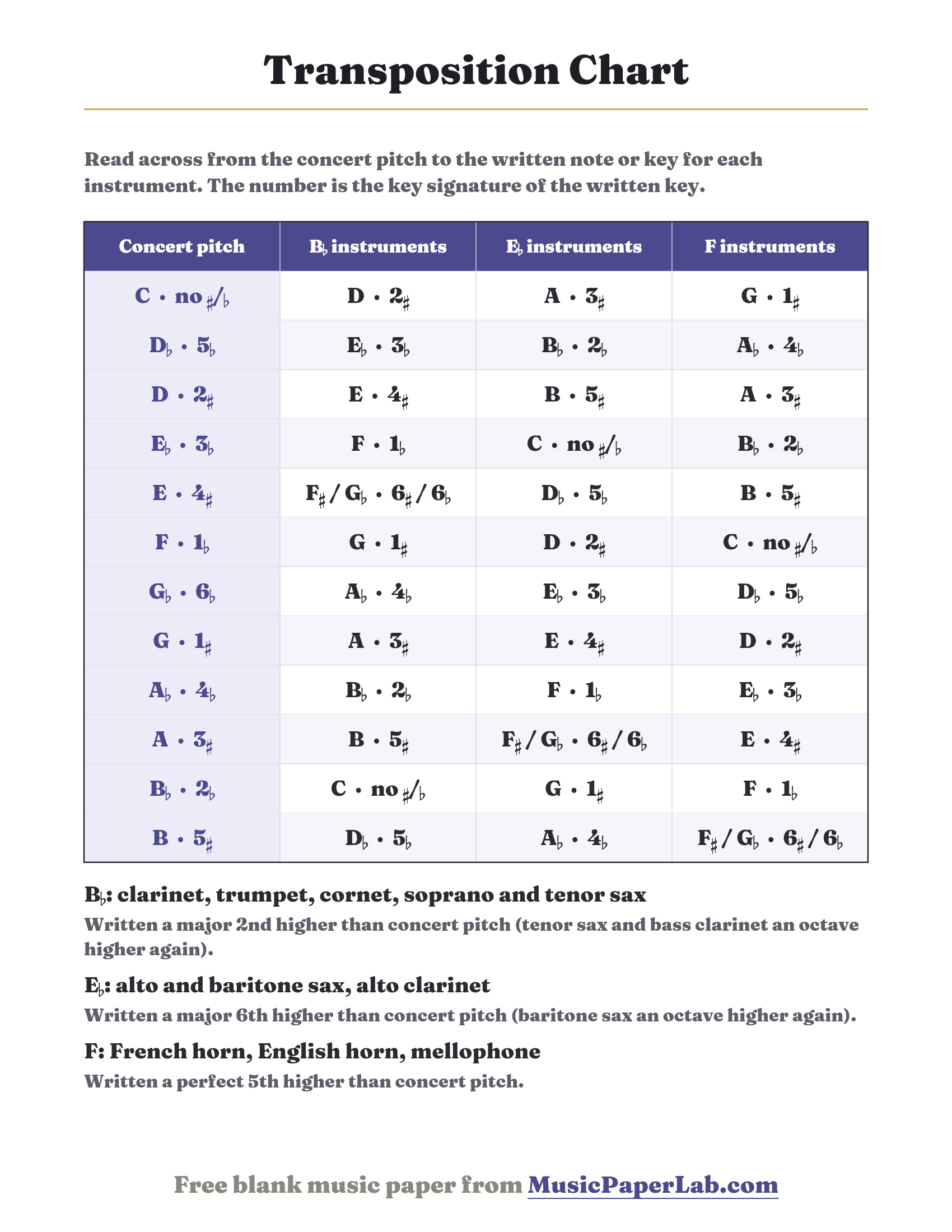
Concert pitch to written pitch
| Concert pitch | B♭ instruments | E♭ instruments | F instruments |
|---|---|---|---|
| C (no ♯/♭) | D (2♯) | A (3♯) | G (1♯) |
| D♭ (5♭) | E♭ (3♭) | B♭ (2♭) | A♭ (4♭) |
| D (2♯) | E (4♯) | B (5♯) | A (3♯) |
| E♭ (3♭) | F (1♭) | C (no ♯/♭) | B♭ (2♭) |
| E (4♯) | F♯ / G♭ (6♯ / 6♭) | D♭ (5♭) | B (5♯) |
| F (1♭) | G (1♯) | D (2♯) | C (no ♯/♭) |
| G♭ (6♭) | A♭ (4♭) | E♭ (3♭) | D♭ (5♭) |
| G (1♯) | A (3♯) | E (4♯) | D (2♯) |
| A♭ (4♭) | B♭ (2♭) | F (1♭) | E♭ (3♭) |
| A (3♯) | B (5♯) | F♯ / G♭ (6♯ / 6♭) | E (4♯) |
| B♭ (2♭) | C (no ♯/♭) | G (1♯) | F (1♭) |
| B (5♯) | D♭ (5♭) | A♭ (4♭) | F♯ / G♭ (6♯ / 6♭) |
The figure in brackets is the key signature of that key. Where a written key would need seven sharps, the chart gives the simpler flat spelling, so concert B for a B♭ instrument is written in D♭ rather than C♯. F♯ and G♭ are equally simple and both are shown.
The rules behind the chart
- B♭ instruments are written a major 2nd higher than concert pitch.
- E♭ instruments are written a major 6th higher than concert pitch.
- F instruments are written a perfect 5th higher than concert pitch.
For key signatures there is a shortcut. B♭ instruments add two sharps to the concert key (or take away two flats), E♭ instruments add three sharps, and F instruments add one. Concert E♭ major, with three flats, becomes F major (one flat) for clarinet, C major (no sharps or flats) for alto sax and B♭ major (two flats) for horn.
An instrument is named for the concert note that sounds when it plays a written C. A B♭ clarinet’s written C sounds B♭; a horn in F’s written C sounds F.
Which instruments transpose
| Key | Instruments | How it is written |
|---|---|---|
| C (concert pitch) | flute, oboe, bassoon, trombone, tuba, violin, viola, cello, piano, bass-clef euphonium | Written at the pitch that sounds. |
| B♭ | B♭ clarinet, B♭ trumpet, cornet, flugelhorn, soprano saxophone | Written a major 2nd higher than it sounds. |
| B♭, an octave lower | tenor saxophone, bass clarinet, treble-clef baritone and euphonium | Written a major 9th (an octave plus a major 2nd) higher than it sounds. |
| E♭ | alto saxophone, alto clarinet | Written a major 6th higher than it sounds. |
| E♭, an octave lower | baritone saxophone | Written an octave plus a major 6th higher than it sounds. |
| E♭ (high) | E♭ clarinet | Sounds a minor 3rd higher than written. The note names follow the E♭ column. |
| F | French horn, English horn (cor anglais), mellophone | Written a perfect 5th higher than it sounds. |
| Octave transposers | piccolo (sounds an octave higher), guitar, bass guitar and double bass (sound an octave lower), xylophone and celesta (an octave higher), glockenspiel (two octaves higher) | Same note names, different octave. |
Tenor sax and bass clarinet use the B♭ column; baritone sax uses the E♭ column. They sound an extra octave lower, but the note names are the same. To move a whole song into a new key for singers or guitar, use the chord progression chart or a capo instead.
Transposition chart: frequently asked questions
What is concert pitch?
Concert pitch is the actual sounding pitch, the note a piano would play. Non-transposing instruments like flute, violin and piano read at concert pitch.
Why is a trumpet called a B♭ instrument?
Because when a B♭ trumpet plays a written C, the note that sounds is a concert B♭. The same goes for B♭ clarinet, soprano sax and tenor sax.
What is concert C for an alto saxophone?
A. Alto sax is an E♭ instrument, written a major 6th above concert pitch, so concert C is written as A.
What is concert B♭ for French horn?
F. Horn in F is written a perfect 5th above concert pitch, and a 5th above B♭ is F.
Is the transposition chart free?
Yes. Print it or download the PDF or PNG for free, with no sign-up.
Related charts
Chord progression chart
The chords in every major and minor key
Minor key signatures
All 15 minor keys on treble and bass clef
Capo chart
What each chord shape sounds like on every fret
Key signatures
All 15 major keys, sharps and flats
Circle of fifths
Interactive chart of every key
All music theory charts
Every free reference chart on the site