Capo chart
A capo raises every string by one half step per fret, so the chord shapes you play sound higher than their names. Play a G shape with the capo on fret 2 and you hear A. The chart shows what eight common open shapes sound like on every fret from 1 to 11, and it works backwards too: find the key you need and it tells you where to put the capo.
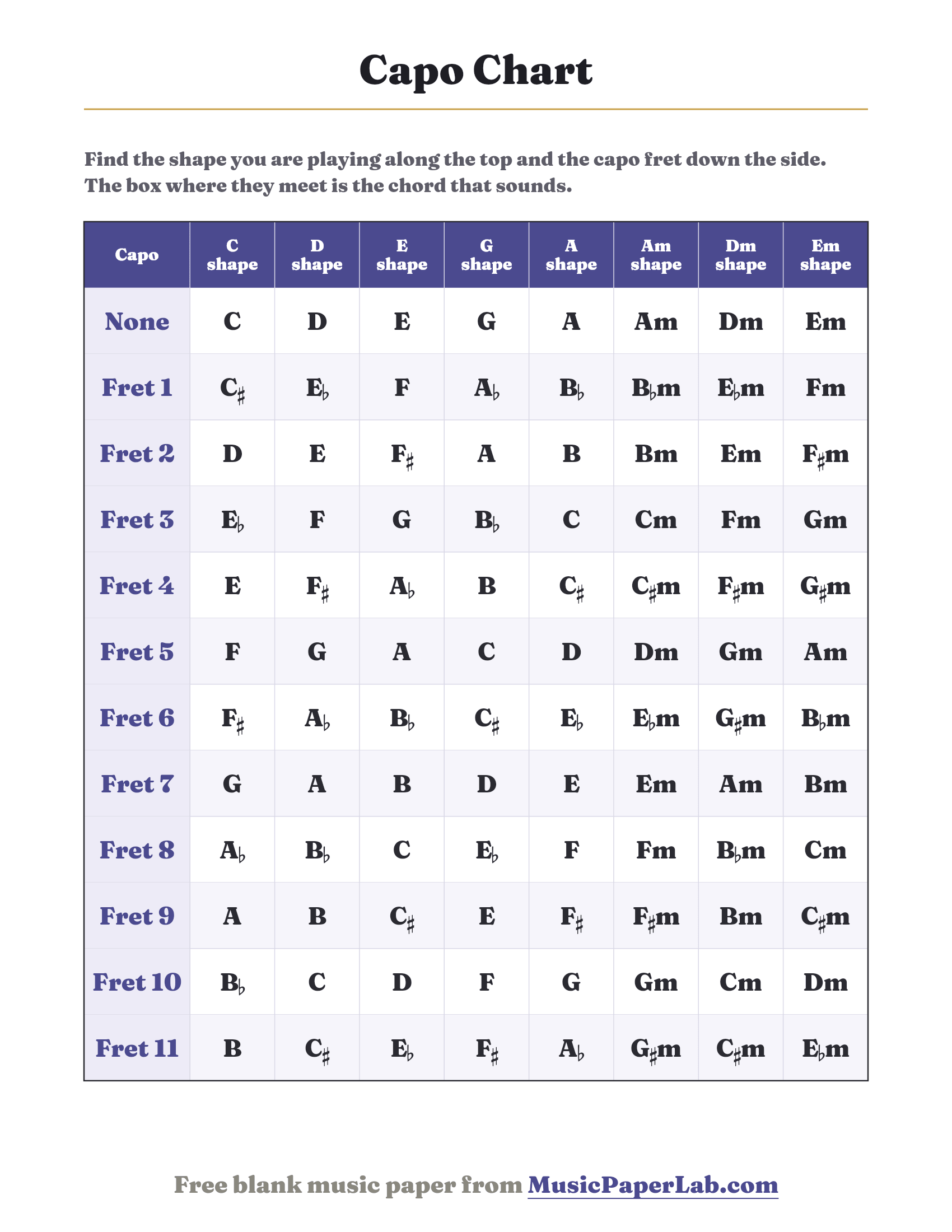
How to read the capo chart
The columns are the chord shapes you finger, named as if there were no capo. The rows are the capo position. Where they meet is the chord that actually sounds. The top row, with no capo, is just the shapes themselves. At fret 12 everything repeats an octave higher, so the chart stops at 11.
Using it backwards: pick a fret for a key
If a song is in a key with awkward chords, choose shapes you know and look for the key in that column. A song in B♭ played with G shapes needs the capo on fret 3. A song in E♭ with C shapes needs fret 3. A minor-key song in F♯m with Em shapes needs fret 2.
There is usually more than one route. Here is every open major shape that reaches A:
| Shape | C | D | E | G | A |
|---|---|---|---|---|---|
| Capo fret for A | 9 | 7 | 5 | 2 | none |
Lower frets keep more of the guitar’s low range and the full sound of the open strings. High capo positions sound bright and small, which can be what you want for a second guitar part.
Why guitarists use a capo
- To match a singer. Moving a song up a few half steps without learning new shapes.
- To avoid barre chords. Keys like E♭, A♭ and B♭ are full of barre chords; a capo turns them into open shapes.
- For the sound. Open shapes ring with open strings, which barre chords in the same key can’t do.
The capo changes the chords that sound but not the shapes, so a chord chart written for the shapes stays the same. If you want the sounding chords instead, the chord progression chart lists every key’s chords, and the guitar chord chart has a diagram for each one.
Capo chart: frequently asked questions
What does a capo do?
A capo clamps across all the strings at one fret, raising every open string by the same number of half steps. Chord shapes played above it keep their fingering but sound higher.
If I put a capo on fret 2 and play a G chord, what chord is it?
A. Each fret raises the pitch by a half step, and G raised two half steps is A.
How do I work out what key I am in with a capo?
Take the key of the shapes you are playing and move it up one half step per fret. G shapes with the capo on fret 3 put you in B♭.
Does a capo chart work for ukulele?
Yes. A capo raises a ukulele’s strings the same way, so the chart works for any shape whose name you know. The uke’s C shape (0003) with the capo on fret 2 sounds as D.
Is the capo chart free?
Yes. Print it or download the PDF or PNG for free, with no sign-up.
Related charts
Chord progression chart
The chords in every major and minor key
Transposition chart
Concert pitch for B♭, E♭ and F instruments
Guitar chord chart
Shapes for every major and minor chord
Guitar notes chart
Every note on the fretboard
Ukulele chord chart
All the uke shapes
All music theory charts
Every free reference chart on the site