Minor key signatures
Every minor key borrows the key signature of its relative major, the major key three half steps higher. A minor has C major’s empty signature, E minor has G major’s single sharp, D minor has F major’s single flat. The chart shows all 15 minor key signatures on both the treble and bass staves.
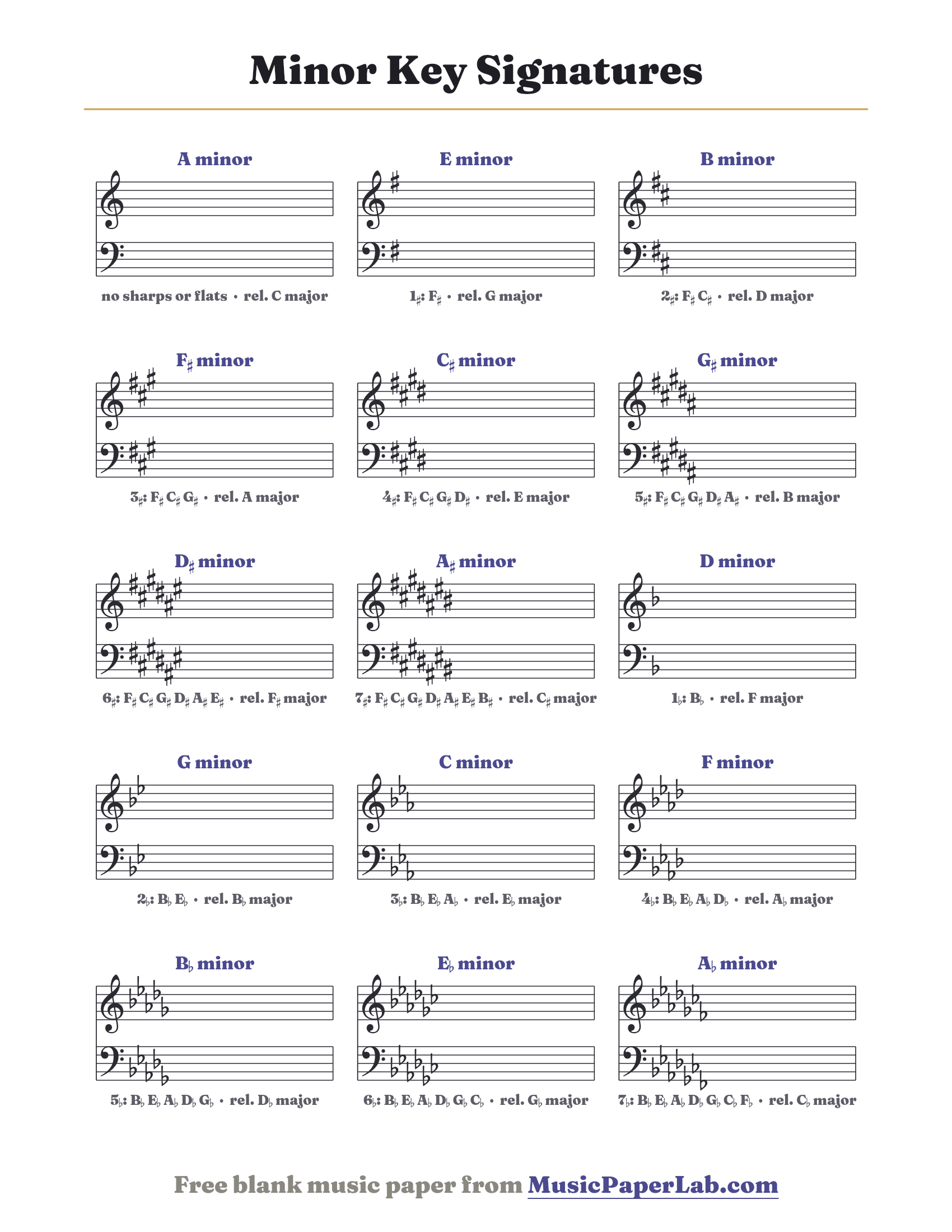
All 15 minor keys
| Minor key | Key signature | Relative major |
|---|---|---|
| A minor | no sharps or flats | C major |
| E minor | 1 sharp: F♯ | G major |
| B minor | 2 sharps: F♯ C♯ | D major |
| F♯ minor | 3 sharps: F♯ C♯ G♯ | A major |
| C♯ minor | 4 sharps: F♯ C♯ G♯ D♯ | E major |
| G♯ minor | 5 sharps: F♯ C♯ G♯ D♯ A♯ | B major |
| D♯ minor | 6 sharps: F♯ C♯ G♯ D♯ A♯ E♯ | F♯ major |
| A♯ minor | 7 sharps: F♯ C♯ G♯ D♯ A♯ E♯ B♯ | C♯ major |
| D minor | 1 flat: B♭ | F major |
| G minor | 2 flats: B♭ E♭ | B♭ major |
| C minor | 3 flats: B♭ E♭ A♭ | E♭ major |
| F minor | 4 flats: B♭ E♭ A♭ D♭ | A♭ major |
| B♭ minor | 5 flats: B♭ E♭ A♭ D♭ G♭ | D♭ major |
| E♭ minor | 6 flats: B♭ E♭ A♭ D♭ G♭ C♭ | G♭ major |
| A♭ minor | 7 flats: B♭ E♭ A♭ D♭ G♭ C♭ F♭ | C♭ major |
The sharps and flats always appear in the same order, whichever key they belong to: sharps F♯ C♯ G♯ D♯ A♯ E♯ B♯ and flats B♭ E♭ A♭ D♭ G♭ C♭ F♭. Each major key has its own page with a large chart; the links in the right-hand column go there.
Finding the relative minor
From any major key, go down three half steps and two letter names. C major goes down to A minor (C, B, B♭, A), and E♭ major goes down to C minor. Another way: the relative minor starts on the 6th note of the major scale. To go the other way, from minor to major, count up three half steps.
On the circle of fifths the relative minors make up the inner ring, each one directly inside its major key. Tap any key there to see its signature, scale and chords.
Telling a minor key from a major one
Because the two keys share a signature, the signature alone can’t tell you which one a piece is in. Three clues help:
- The last note and chord. Most pieces end on their home chord. A piece with no sharps or flats that ends on an A minor chord is almost certainly in A minor.
- The first chord. Pieces usually start on the home chord too.
- A raised 7th. Minor-key music usually raises the 7th note of the scale with an accidental, so look for G♯ in A minor, D♯ in E minor or B♮ in C minor. That note is not part of the relative major’s scale.
Minor keys that sound the same
Three pairs of minor keys are enharmonic: they sound identical but are spelled differently.
- G♯ minor (5 sharps: F♯ C♯ G♯ D♯ A♯) and A♭ minor (7 flats: B♭ E♭ A♭ D♭ G♭ C♭ F♭)
- D♯ minor (6 sharps: F♯ C♯ G♯ D♯ A♯ E♯) and E♭ minor (6 flats: B♭ E♭ A♭ D♭ G♭ C♭)
- A♯ minor (7 sharps: F♯ C♯ G♯ D♯ A♯ E♯ B♯) and B♭ minor (5 flats: B♭ E♭ A♭ D♭ G♭)
Composers pick whichever spelling is easier to read, which usually means the one with fewer sharps or flats. To see which chords belong to each minor key, use the chord progression chart.
Minor key signatures: frequently asked questions
How many minor key signatures are there?
Fifteen written minor keys, the same as the major keys. Three pairs sound the same and differ only in spelling: G♯ minor and A♭ minor, D♯ minor and E♭ minor, A♯ minor and B♭ minor.
Which minor key has one sharp?
E minor. It shares its signature, F♯, with G major.
Which minor key has one flat?
D minor. It shares its signature, B♭, with F major.
How do I know if a piece is in a major or minor key?
The key signature is the same for both, so look at the music. A piece usually ends on its home chord, and minor-key music tends to raise its 7th note with an accidental: G♯ in A minor, D♯ in E minor, B♮ in C minor.
Is the minor key signatures chart free?
Yes. Print it or download the PDF or PNG for free, with no sign-up.
Related charts
Chord progression chart
The chords in every major and minor key
Transposition chart
Concert pitch for B♭, E♭ and F instruments
Time signatures
What 4/4, 3/4, 6/8 and the rest mean
Major key signatures
All 15 major keys, one chart each
Circle of fifths
Interactive: every key and its relative minor
All music theory charts
Every free reference chart on the site