Ledger lines
Ledger lines are the short lines added above or below the staff for notes that don’t fit on its five lines. They carry on the staff’s pattern of line, space, line, space. The chart names every note on up to three ledger lines above and below the treble and bass staves, with middle C marked.
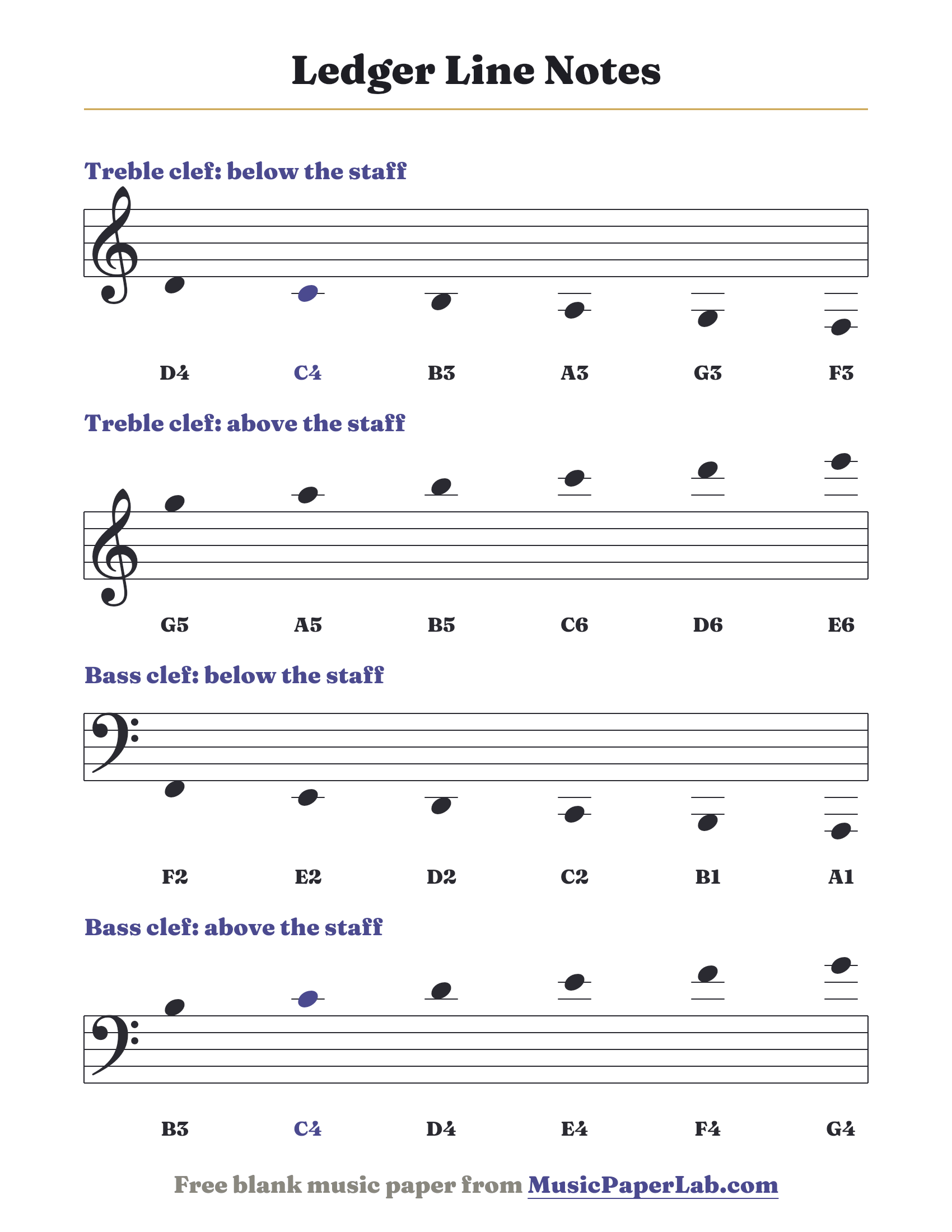
How ledger lines work
A ledger line is spaced exactly like a staff line, so the note on the first ledger line above the staff is two steps above the top line, and the space beyond it is one step further. Each ledger line is drawn only as wide as the note head, and only as many are drawn as the note needs: a note sitting in the space above the first ledger line uses that one line, not two.
The note names come from the clef, the same as on the staff. In the table, octave numbers follow the usual convention where middle C is C4.
| Where the note sits | Treble clef | Bass clef |
|---|---|---|
| On the third ledger line above the staff | E6 | G4 |
| Above the second ledger line | D6 | F4 |
| On the second ledger line above the staff | C6 | E4 |
| Above the first ledger line | B5 | D4 |
| On a ledger line above the staff | A5 | C4 (middle C) |
| Just above the staff | G5 | B3 |
| Just below the staff | D4 | F2 |
| On a ledger line below the staff | C4 (middle C) | E2 |
| Below the first ledger line | B3 | D2 |
| On the second ledger line below the staff | A3 | C2 |
| Below the second ledger line | G3 | B1 |
| On the third ledger line below the staff | F3 | A1 |
Middle C and the grand staff
The ledger line you will meet most is middle C. On the treble clef it sits on one ledger line below the staff; on the bass clef, one ledger line above. On the grand staff those two positions are the same key on the piano, which is how notes pass from one hand’s staff to the other. The piano keys chart shows the match key by key.
When music avoids ledger lines
Past three or four ledger lines, notes get slow to read, so composers use other tools. An 8va sign over the notes means play them an octave higher than written, and 8vb under them means an octave lower. Instruments with a wide range switch clef instead: cellists and bassoonists move into the tenor clef for high passages so the notes stay on the staff.
To drill these notes, the treble clef and bass clef pages each have a quiz with a ledger-line setting.
Ledger lines: frequently asked questions
What is a ledger line?
A short line drawn above or below the staff for a note that is too high or too low to fit on the five staff lines. It is only as wide as the note, and it continues the staff’s line-space pattern.
What note is on the first ledger line above the treble staff?
A5. The space above it is B5, and the second ledger line up is C6.
What note is on the first ledger line below the bass staff?
E2. The space below it is D2, and the second ledger line down is C2.
Is middle C on a ledger line?
Yes. Middle C (C4) sits on one ledger line below the treble staff, or on one ledger line above the bass staff. Both are the same note.
Is the ledger lines chart free?
Yes. Print it or download the PDF or PNG for free, with no sign-up.
Related charts
The music staff
Lines, spaces and the parts of a staff
Piano keys labeled
Every key named, plus a piano notes chart
Time signatures
What 4/4, 3/4, 6/8 and the rest mean
Treble clef notes
Chart and a note quiz with ledger lines
Bass clef notes
Chart and a note quiz with ledger lines
All music theory charts
Every free reference chart on the site