The music staff
A music staff, also called a stave, is the set of five horizontal lines that notes are written on. Each line and each space between the lines stands for one pitch, and the higher a note sits, the higher it sounds. The chart labels the lines and spaces and the parts of a staff you will see on almost every page of sheet music.
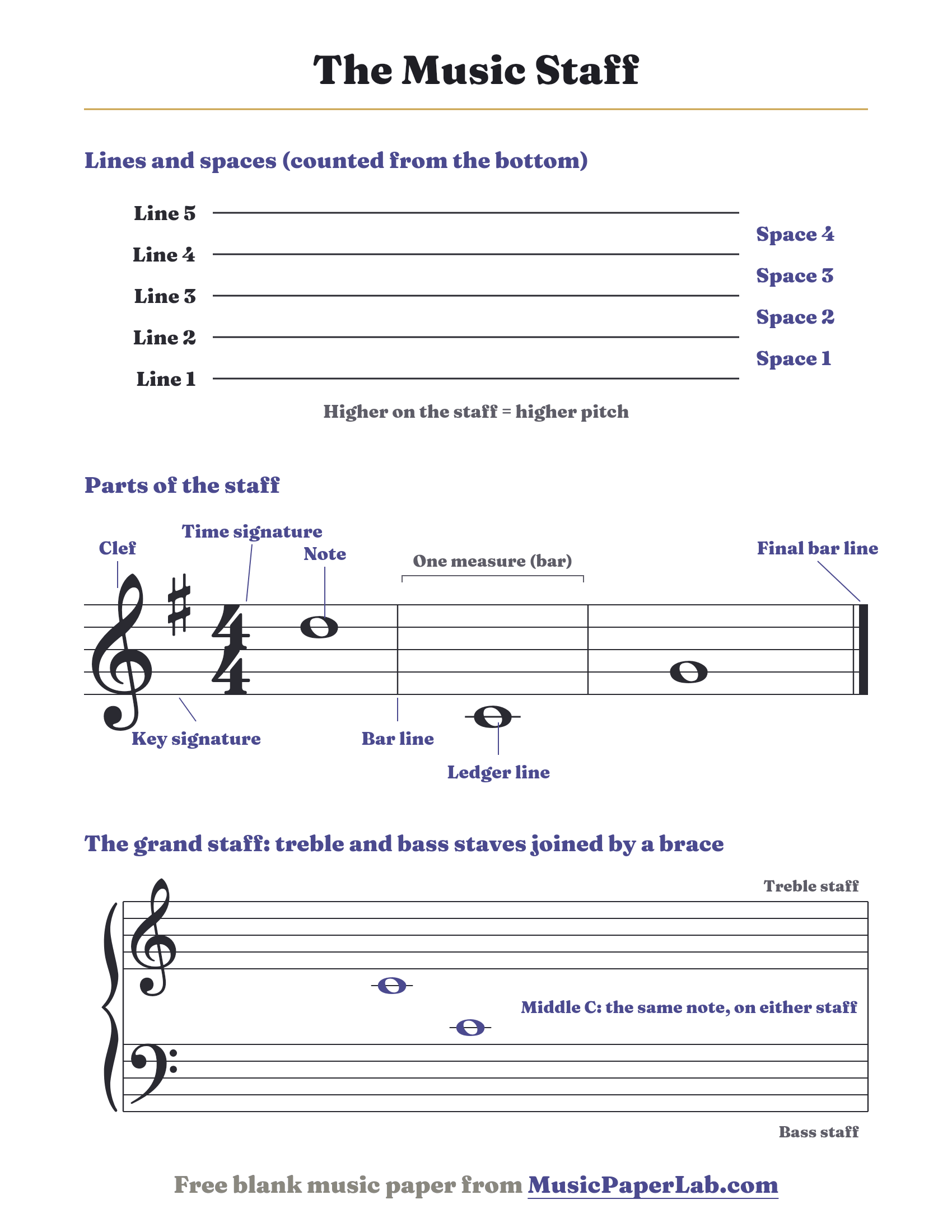
Lines and spaces
The staff has five lines and four spaces, always counted from the bottom up. A note is either on a line, with the line running through its middle, or in a space, sitting between two lines. Moving from a line to the space just above it is one step up the musical alphabet: A B C D E F G, then A again.
The clef sets the notes
On its own, a staff doesn’t say which notes its lines are. The clef at the start does. The same bottom line is E with a treble clef and G with a bass clef.
| Clef | Lines (bottom to top) | Spaces (bottom to top) |
|---|---|---|
| Treble clef | E G B D F | F A C E |
| Bass clef | G B D F A | A C E G |
| Alto clef | F A C E G | G B D F |
| Tenor clef | D F A C E | E G B D |
Each clef page has a printable chart and a short note-naming quiz. The treble and bass clefs cover most music; the alto and tenor clefs are read by violas, cellos, bassoons and trombones.
Parts of the staff
- Clef
- The symbol at the left edge. It fixes the pitch of one line, and the rest follow from it.
- Key signature
- The sharps or flats right after the clef. They apply to those notes for the whole piece. See the key signature charts.
- Time signature
- The two stacked numbers after the key signature: how many beats are in each measure and which note gets the beat. See time signatures.
- Bar lines and measures
- Vertical lines that divide the staff into measures (also called bars) of equal length.
- Ledger lines
- Short extra lines for notes above or below the staff. Middle C on the treble clef sits on one. See ledger lines.
- Final bar line
- A thin line followed by a thick one, marking the end of the piece.
The grand staff
Piano, harp and organ music uses two staves at once: a treble staff above a bass staff, joined at the left by a brace. That pairing is the grand staff, and middle C sits between its two halves. The guide What is the grand staff? covers it in more detail, with a chart of every note from G2 to F5.
To practice writing notes, print some blank staff paper or grand staff paper.
Music staff: frequently asked questions
How many lines does a music staff have?
Five lines and four spaces. They are counted from the bottom up, so line 1 is the lowest line.
Is it a staff or a stave?
Both. "Staff" is the usual word in the US and "stave" is common in the UK. The plural is "staves" either way.
What are the notes on the staff?
That depends on the clef. With a treble clef the lines are E G B D F and the spaces F A C E. With a bass clef the lines are G B D F A and the spaces A C E G.
What is a staff with two clefs called?
A treble staff and a bass staff joined by a brace is a grand staff. Piano music is written on it, one staff for each hand.
Is the staff chart free to print?
Yes. Print it or download the PDF or PNG for free, with no sign-up.
Related charts
Ledger lines
Notes above and below the treble and bass staves
Time signatures
What 4/4, 3/4, 6/8 and the rest mean
Piano keys labeled
Every key named, plus a piano notes chart
Clef notes
Note names and quizzes for every clef
Blank staff paper
Print staves to write on
All music theory charts
Every free reference chart on the site