Drum key
Drum music is written on the same five-line staff as other music, but each line and space stands for a part of the kit instead of a pitch. A drum key shows which is which. The layout here is the one most drum books, method books and published transcriptions use.
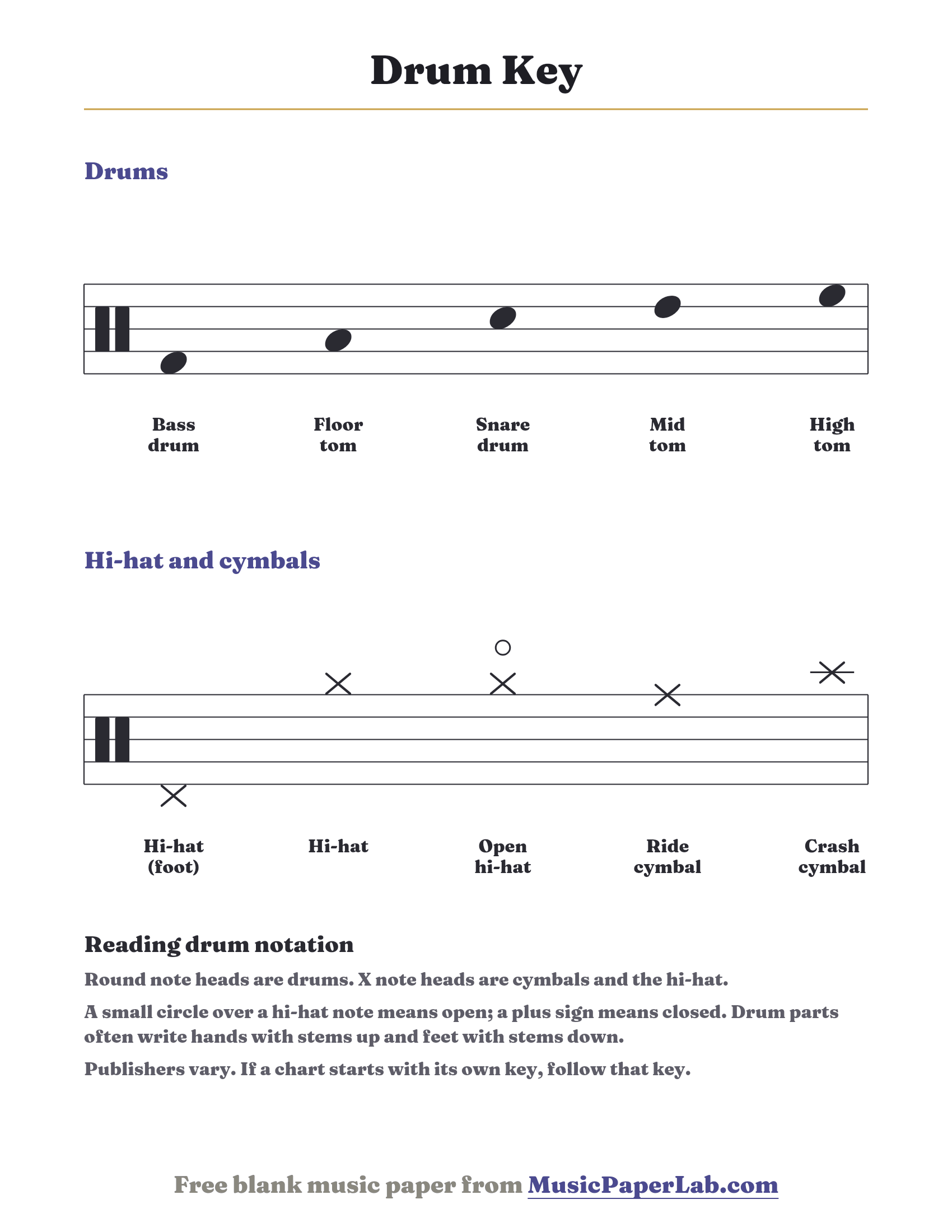
Where each part of the kit is written
| Part | Position on the staff | Note head |
|---|---|---|
| Bass drum | Bottom space | round (filled) |
| Floor tom | Second space | round (filled) |
| Snare drum | Third space | round (filled) |
| Mid tom | Fourth line | round (filled) |
| High tom | Top space | round (filled) |
| Hi-hat (foot) | Space below the staff | x |
| Hi-hat | Space above the staff | x |
| Open hi-hat | Space above the staff, with a small circle | x |
| Ride cymbal | Top line | x |
| Crash cymbal | Ledger line above the staff | x |
The pattern is easy to remember: the drums run from low to high up the staff (bass drum, floor tom, snare, then the two rack toms), and the cymbals sit on and above the top line.
Note heads, stems and hi-hat marks
Round note heads are drums and x note heads are cymbals. When a part is written in two voices, the hands (hi-hat, snare, toms, cymbals) have stems pointing up and the feet (bass drum, hi-hat pedal) have stems pointing down, so you can see at a glance what each limb plays.
Over a hi-hat note, a small circle means play it open and a plus sign means closed. Accents, rolls and flams use the same symbols as other music; the articulation chart covers the accent marks.
A basic rock beat, read from the key
In a standard 4/4 rock beat you will see x’s just above the top line for eighth notes on the hi-hat, a note in the third space on beats 2 and 4 for the snare, and notes in the bottom space on beats 1 and 3 for the bass drum. Count it “1 and 2 and 3 and 4 and”: hi-hat on every count, bass drum on 1 and 3, snare on 2 and 4.
When a chart uses a different layout
Drum notation is less standardized than pitched notation. Some books put the ride on the space above the staff, write a second floor tom on the bottom line, or use a different mark for the cross-stick. Good charts print their own key on the first page; when they do, follow it over this one. To write your own parts, print some blank drum sheet music.
Drum key: frequently asked questions
What do the x’s mean in drum music?
An x note head is a cymbal or the hi-hat. Round note heads are drums. The position of the x on the staff tells you which cymbal.
Where is the snare drum on the staff?
In the third space, the second space from the top. It is the most-written note in most drum parts.
Where is the bass drum written?
In the bottom space of the staff. The hi-hat played with the foot is written in the space below the staff, with an x.
What clef does drum music use?
A neutral or percussion clef, two short thick vertical lines. It shows the lines and spaces stand for instruments rather than pitches.
Is the drum key free to print?
Yes. Print it or download the PDF or PNG for free, with no sign-up.