Key signatures with 5 flats
A key signature with 5 flats is D♭ major, or its relative minor B♭ minor. The flats are B♭ E♭ A♭ D♭ G♭, always written in that order. The chart below shows it on the treble staff — free to print or download.
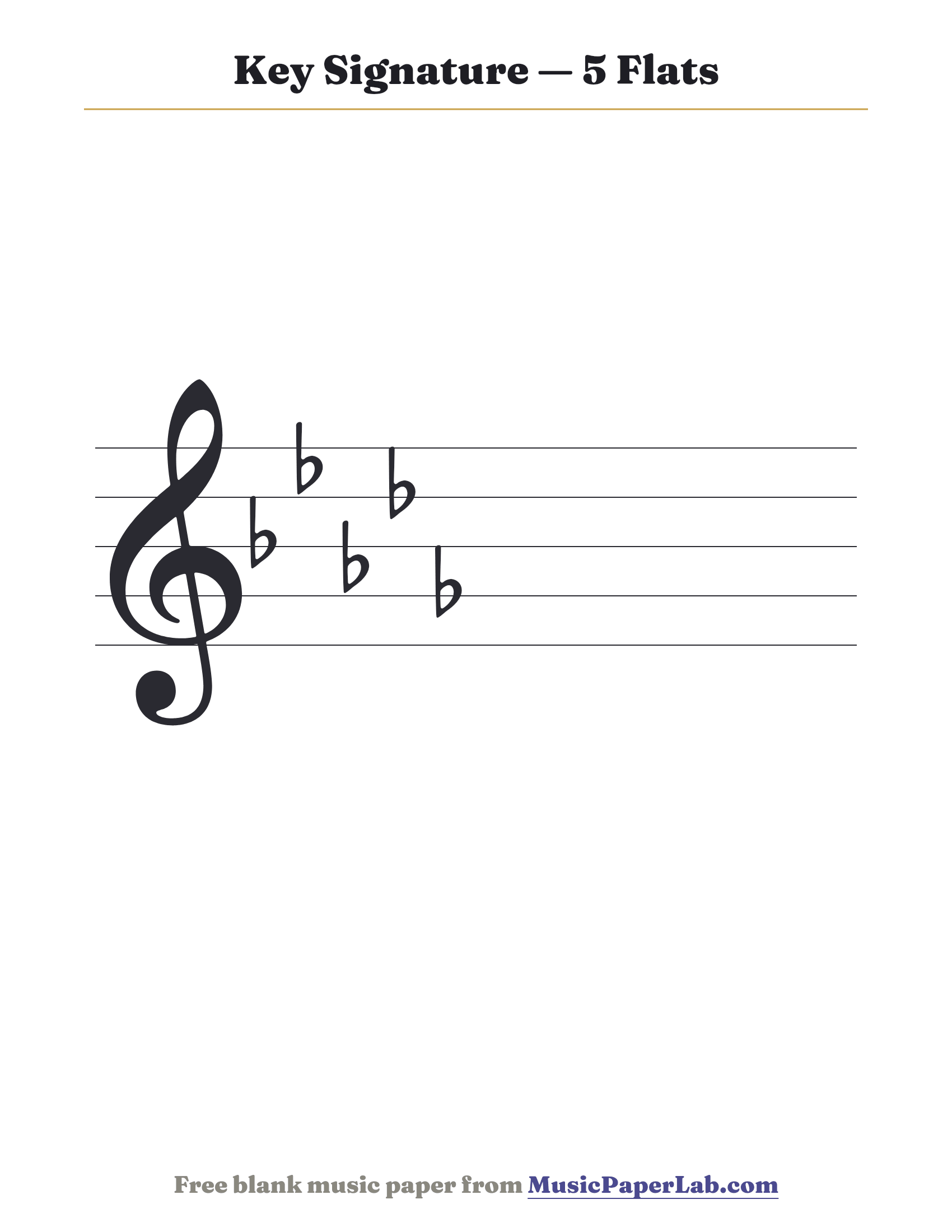
Which key has 5 flats?
Two keys share every signature — one major, one minor. 5 flats means D♭ major or its relative minor B♭ minor, and nothing else: the seven sharp keys and seven flat keys each use a different number of accidentals, so the count alone identifies the pair. The steps below show how to name it from the staff without memorising a table.
How to read it
- Count the flats. Count the accidentals sitting between the clef and the time signature. Five of them narrow it to one major key and one relative minor.
- Name the major key. The second-to-last flat names the key directly — here that is D♭, so the key is D♭ major.
- Name the relative minor. Count down three semitones from D♭ — or up six steps round the circle of fifths — to reach B♭ minor, which shares this signature.
- Check the melody. The signature alone cannot tell you which of the two the piece is in. Look at the first and last notes: D♭ major and B♭ minor use identical notes, so the music decides.
The order of flats
Flats never appear in an arbitrary order. They are added one at a time in the fixed sequence B♭ E♭ A♭ D♭ G♭ C♭ F♭, so a signature with 5 flats always uses the first five of them: B♭ E♭ A♭ D♭ G♭. That is why counting the accidentals is enough to name the key — you also know exactly which ones they will be.
5 flats or 7 sharps?
D♭ major (5 flats) and C♯ major (7 sharps) are enharmonic equivalents: on a keyboard they are the same pitches, written with different note names. Editors choose whichever spelling gives the performer fewer awkward accidentals to read.
Key signatures with 5 flats — frequently asked questions
Which key has 5 flats?
A key signature with 5 flats is D♭ major, or its relative minor B♭ minor. The flats are B♭ E♭ A♭ D♭ G♭, always written in that order.
What are the flats in the D♭ major key signature?
The flats are B♭ E♭ A♭ D♭ G♭, always written in that order. Flats are always added in the fixed order B♭ E♭ A♭ D♭ G♭ C♭ F♭, so a signature with 5 flats always uses the first 5.
How do I tell D♭ major from B♭ minor?
You cannot tell from the key signature — they share it. D♭ major and B♭ minor contain exactly the same notes; the melody, the opening chord and the final note tell you which one the piece is really in.
Is 5 flats the same as 7 sharps?
They sound the same but are written differently. D♭ major (5 flats) and C♯ major (7 sharps) are enharmonic equivalents — the same pitches on a keyboard, spelled with different note names. Composers pick whichever is easier to read.
Is the chart free to print?
Yes — print it or download the PDF or PNG for free, with no account and no sign-up.
Look up another key signature
By number of sharps
Key signatures with 1 sharp
G major · E minor
Key signatures with 2 sharps
D major · B minor
Key signatures with 3 sharps
A major · F♯ minor
Key signatures with 4 sharps
E major · C♯ minor
Key signatures with 5 sharps
B major · G♯ minor
Key signatures with 6 sharps
F♯ major · D♯ minor
Key signatures with 7 sharps
C♯ major · A♯ minor
By number of flats
Key signatures with 1 flat
F major · D minor
Key signatures with 2 flats
B♭ major · G minor
Key signatures with 3 flats
E♭ major · C minor
Key signatures with 4 flats
A♭ major · F minor
Key signatures with 5 flats
D♭ major · B♭ minor
Key signatures with 6 flats
G♭ major · E♭ minor
Key signatures with 7 flats
C♭ major · A♭ minor
See every key laid out by its signature on the circle of fifths, test yourself with a blank circle of fifths, browse all 15 major key signatures, learn the notes on the treble clef, or read the guide to reading sheet music.